
Weekly Market Snapshot
Edition #1

Bruin Finance Journal, January 12, 2026
In this edition:
Welcome to Bruin Finance Journal’s Weekly Market Snapshot!
Market Snapshot:
Rates, Trends, and Drivers
Key Drivers vs. Headwinds
Three Key Highlights
Deep Dives:
The Morning Star Pattern: A Short-Term Behavior Indicator
The Birth & Death of Cable TV and Movie Theaters
Welcome to Bruin Finance Society’s Weekly Market Snapshot!
Welcome to the Bruin Finance Society’s Weekly Market Snapshot (WMS)! The WMS is built around a simple value proposition: fast, digestible, and dependable updates for UCLA students.
Each edition delivers a structured read that works at two speeds. If you have a few minutes between classes, you can skim the headlines and leave with a clear sense of what mattered and why. If you have more time, you can go deeper into the mechanisms behind the move, the evidence supporting it, and the implications for investors and students preparing for careers in finance.
Here is what you can expect every week:
Market Snapshot:
Rates, trends, and the key drivers shaping pricing across major assets.
2 Ws and 1 L for three tickers.
Three key highlights that capture recent developments, and the “so what” behind them.
Deep Dives
Longer-form pieces written by BFS members. These will range from technical patterns and indicators to industry shifts and business-model breakdowns.
This week’s contributors: Daniel Xing, Alexis Muchnik, Nathan Gong
For students interested in joining Bruin Finance Society as an intern: Application Link.
Market Snapshot
Rates, Trends, and Drivers
📉 Market Indexes
S&P 500: +1.6% w/w
Nasdaq: +1.9% w/w
Russell 2000: +4.6% w/w
Equities rallied to a record high this Friday, primarily lifted by chip manufacturers such as Broadcom. The mixed December jobs report, with slower hiring but a lower unemployment rate, reduced immediate recession concerns, while keeping longer-term rate cuts on the table, supporting risk appetite and pushing major indexes to new highs.
💵 Rates
2Y Treasury: 3.54% ↑
10Y Treasury: 4.18% ↑
Treasury yields rose as investors further pushed back expectations for near-term Fed easing amid resilient economic data, which in turn supported a stronger U.S. dollar through higher relative yields.
🌍 Key Macro
U.S. Dollar (DXY): ~ 99.1 (+0.72% w/w)
WTI Oil: ~$59 (+3.14% w/w)
Gold: ~$4,500 (+3.96% w/w)
Oil prices rose on renewed supply-risk concerns tied to geopolitics, and gold gained as investors increased demand for safe-haven assets amid policy and geopolitical uncertainty.
Key Drivers vs. Headwinds
🟢 Vistra
▲ ~10% surge on Friday as Meta signed a 20-year deal agreeing to buy energy from Vistra’s nuclear energy plants to supply AI data centers.
🟢 Intel
▲ ~10% this week after Trump said he had a “great meeting” with Intel’s CEO Lip-Bu Tan.
🔴 General Motors
▼ ~3% on Friday after announcing that they were scaling back a $6 billion investment in EVs, citing weakened demand and decreased tax incentives.
Three Key Highlights
Iran protests and markets
Escalating protests and a harsh government crackdown in Iran have elevated geopolitical risk in a key oil-producing region, which markets view as a potential supply threat. As demonstrations spread nationwide and internet blackouts were implemented to hinder communication, traders became more concerned that unrest could disrupt crude exports or destabilize regional infrastructure. This sentiment has pushed oil prices higher for three straight weeks, with Brent crude approaching $63 a barrel, as risk premiums were priced into futures.
Higher oil prices have ripple effects: energy companies and commodity-linked stocks often benefit, while higher energy costs feed into broader inflation expectations. Elevated inflation forecasts can delay expectations of interest rate cuts, keeping bond yields elevated and reducing the relative attractiveness of growth stocks. As a result, cyclical and energy equities have shown strength relative to rate-sensitive sectors. In short, Iran’s unrest heightened perceived supply risk, which helped lift oil benchmarks and shift market positioning across sectors.
Venezuela’s oil developments and markets
Recent policy developments around Venezuela have drawn market attention to the potential for increased crude supply, despite structural challenges remaining. The U.S. government agreed to allow up to $2 billion worth of Venezuelan oil exports to flow to U.S. refineries, a meaningful volume given Venezuela’s recent output below ~1 million barrels per day.
This shift pressured oil prices on the view that additional heavy crude could loosen supply constraints, with traders factoring in the possibility of more barrels moving into global markets. However, Venezuela’s oil sector has been hampered for years by underinvestment, logistical bottlenecks, and sanction-related production issues. Because of that, energy markets remain volatile rather than fully pricing in a supply surge. The result is that broad energy benchmarks and oil-linked equities have shown mixed movement as investors balance potential supply increases against execution and political risk.
AI power demand and the “5-layer AI cake.”
The “5-layer AI cake,” described by Jensen Huang, explains how AI growth depends on multiple stacked inputs: energy, chips, data centers, models, and software applications. Markets focus heavily on the bottom layer, energy, because nothing else works without reliable electricity.
AI models require enormous computing power, and computing power requires electricity. As companies like Meta expand AI infrastructure, their power needs rise sharply. That is why Meta signed long-term nuclear power agreements. Stable energy supply reduces the risk of outages and helps control costs
This shift matters for investors because it changes which companies benefit first. Utilities, power generators, and grid infrastructure firms see demand earlier than software companies. As energy demand forecasts rise, markets reprice stocks tied to electricity generation and data centers before moving up the stack to chips and applications. In short, AI growth starts with power, so markets follow the power.
Deep Dive
The Morning Star Pattern: A Short-Term Behavioral Indicator
By Alexis Muchnik
The Morning Star pattern refers to a candlestick pattern that can be used to predict a short-term reversal from a downtrend to an uptrend, making it useful for analysts and investors. While the pattern itself does not guarantee a shift, analysts can use external factors to confirm the predicted effect of the pattern (Chen 2025a).
The pattern is found on a candlestick chart, a diagram that displays the high, low, opening, and closing prices for a stock – the edges of the wide part of a candlestick chart display the opening and closing prices while the narrow parts show the high and low prices – and how these prices compare to each other. White or green candles indicate a rise in share prices, while red or black candles indicate a fall in share prices (Hayes 2025). The Morning Star pattern is characterized by a tall black or red candle followed by a smaller candle that is either white/green or red/black, which indicates indecision in the market, typically following a downward trend. These two candles should be followed by a tall green candle confirming the trend reversal. The Morning Star pattern is a recognizable visual indicator of a trend reversal, however, the pattern itself is unreliable without additional technical indicators, such as trading volume. High volume on the third session is usually automatically seen as confirmation of the trend reversal (Chen 2025a).
One variation on the Morning Star pattern is the Doji Morning Star pattern (Chen 2025a). A doji is the name for a session in which the open and close prices were almost equal as represented on a candlestick chart (Chen 2025b). In the Doji Morning Star pattern, the chart displays a long black/red candle followed by a doji. These two candles should be followed by a longer white/green candle and a larger volume spike because investors may be better able to identify the pattern prior to the close of the third session (Chen 2025a). The opposite of a Morning Star pattern is an Evening Star pattern, characterized by a green/white candle followed by a smaller candle of either nature (Chen 2025a, Fernando 2025). These candles should be followed by a larger red/black candle to predict a downward trend reversal, opposed to the upward trend reversal of the Morning Star pattern. This pattern, however, can be hard to identify due to noisy data and often requires additional tools to accurately identify a trend of future decline (Fernando 2025).
The Morning Star pattern, as well as the doji variations and its opposite, the Evening Star pattern, can be a useful tool for analysts and beginning traders alike to predict market trends. However, these patterns are rarely useful alone and require external analysis of market behaviors and trends (Chen 2025a, Fernando 2025).
The Birth & Death of Cable TV and Movie Theaters
By Nathan Gong
The Evolution of the Screen: From Nickelodeons to the Streaming Age
At the dawn of the 20th century, the “magic lantern” evolved into the cinema, creating the pre-recorded asynchronous entertainment industry. At first, it was small. In the early 1900s, movie theaters were small-scale novelties, defined by silent films and five-cent admissions. However, the late 1920s introduced “talkies,” transforming cinema into a vertical-industry titan. Soon, five major studios: Paramount, Warner, Loews, Fox, and RKO, established an oligopoly that defined the Golden Age of Hollywood, controlling everything from production to the physical theaters where films were screened.
The Rise of the Living Room
The first major threat to the silver screen arrived in the 1920s: the television. While initially a luxury, the post-WWII economic boom of the 1950s made the TV a household staple. With the rise of color TV in the 1970s, the market truly shifted. Networks, already experimenting with creating paid TV networks (instead of simply broadcasting networks freely through public airwaves) created a new diverse paid, set of cable networks like ESPN, MTV, and CNN that led to a rise of TV viewership and cable TV adoption, increasing the number of paid customers from 16 million to 50 million. The introduction of the VHS was also big, allowing movie studios to double-monetize films by premiering them in theaters, then re-releasing them in the living room. Although great for movie studios, these technological changes triggered a long-term slump in theater attendance.
The Digital Disruption
The 1990s and 2000s saw the death of traditional media. DVDs, the new VHS replacement, offered high-definition clarity that rivaled the theater experience, fueling the rise of rental giants like Blockbuster and Netflix. However, the true “theatre killer” was high-speed internet. YouTube’s ever-growing media library democratized content creation, allowing creators like MrBeast and companies like BuzzFeed to build media empires that rival traditional networks.
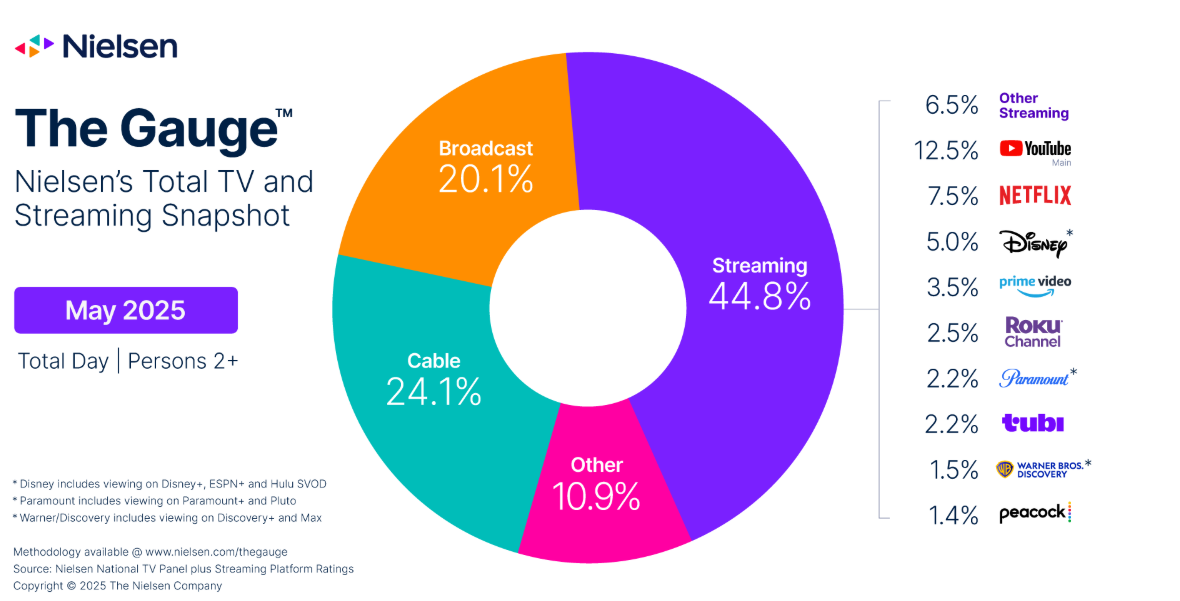
Streaming services were also invented, offering vast libraries of content on demand. Unlike traditional cable, which relied on rigid broadcast schedules, platforms like Netflix allowed users to “binge-watch” at their own pace. Traditional TV has gone digital as well. Concurrently, traditional TV has migrated to the digital space through Free Ad-supported Streaming TV (FAST) platforms like Tubi and Roku. By hosting content once exclusive to networks like ABC, these platforms are capturing the remaining market share from traditional broadcast and cable, both of which are projected to decline by 10-20% annually.
A New Era of Consumed Media
The pandemic served as the ultimate catalyst, sending theater attendance into a free-fall and allowing digital streaming to surpass traditional TV viewership for the first time in history.
Today, the industry stands on the precipice of another seismic shift: the potential acquisition of Warner Bros. by either Netflix or Paramount. This move signals a definitive transition toward “digital-first” distribution that threatens to permanently marginalize the theatrical experience.
While both suitors have publicly pledged to honor “industry standard” theatrical windows, their track records suggest otherwise. Netflix, for instance, frequently utilizes “token” theatrical releases, screening high-profile projects like Guillermo del Toro’s Frankenstein in theaters for the bare minimum two-week period required for award eligibility, before tucking them behind a paywall.
Ultimately, these acquisitions accelerate a winner-take-all digital arms race. As studios prioritize their own ecosystems over third-party exhibitors, the communal experience of the cinema and broadcast & cable TV are being relegated to the past. What was once the cultural bedrock of the 20th century is fast becoming a relic, replaced by entertainment increasingly confined to the palm of your hand.